
What Happens If You Only Pay the Minimum on Your Credit Card?
 ▶ Play the episode (8:22)
Paying only the credit card minimum turned Sam's $3,000 card into 15 years of payments and $4,433 of interest. Here's why the minimum payment works that way, the warning box US card statements must show, and the one rule that beats it.
What you'll learn
- Why an $85 minimum on a $3,000 card can take about 15 years and cost $4,433 in interest
- The "Minimum Payment Warning" box US card statements must show, and the 3-year payment it shows
- The one rule that beats the trap: pick a fixed payment and never let it shrink
- How new purchases and a lost grace period keep you on the debt treadmill
- Three moves to get out: automate a fixed payment, stop adding to the card, compare a balance transfer with a plan
The numbers from the episode
Sam's card from the episode, in US dollars: a US$3,000 balance at 22% a year, no new purchases. The minimum is that month's interest plus 1% of the balance, with a $25 floor (a common US card formula; yours may differ).
| Monthly payment | Time to clear | Total interest |
|---|---|---|
| The minimum (starts at $85, then shrinks) | 180 months (15 years) | $4,433 |
| A fixed $85 (the first minimum, kept) | 58 months (just under 5 years) | $1,873 |
| A fixed $100 | 44 months (3 years 8 months) | $1,395 |
| A fixed $150 (Maya) | 26 months | $771 |
| A fixed $200 | 18 months | $541 |
| A fixed $300 | 12 months | $345 |
Keeping the first $85 fixed instead of letting it shrink saves about $2,560 of interest. Starting $65 higher, at a fixed $150, saves about $3,660. Figures are rounded to the dollar.
Chapters
- 0:00 The $85 minimum payment trap
- 0:33 Fifteen years of payments
- 1:05 Same card, different number
- 1:41 Where your $85 goes
- 2:40 The warning box on your statement
- 3:29 Five payments, one card
- 4:12 The one rule that beats the trap
- 4:51 The treadmill and the grace period
- 5:42 Maya's three moves
- 6:47 Try your own numbers
- 7:23 Sam's do-over
Transcript
Read the full transcript
0:00 The $85 minimum payment trap
Sam: Minimum payment, $85. Easy.
This is Sam. And that easy $85 is about to keep him paying for 15 years. On a $3,000 card.
Sam: Wait. 15 years?
Nobody tricked him. No hidden fees. He paid exactly what the card asked for. In the next few minutes, you'll see why that happens, find the box on your statement that admits it, and learn the one rule that gets Sam out in about two years. And at the end, Sam gets a do-over.
0:33 Fifteen years of payments
Let's fast-forward. 2026. $85. 2029. A promotion. Still paying. 2033. A wedding. Still paying. 2037. A baby. Still paying. 2041.
Sam: Done! Finally done!
15 years. $4,433 in interest. More than the card itself. So how does a $3,000 card take 15 years? To see it, we need a second player.
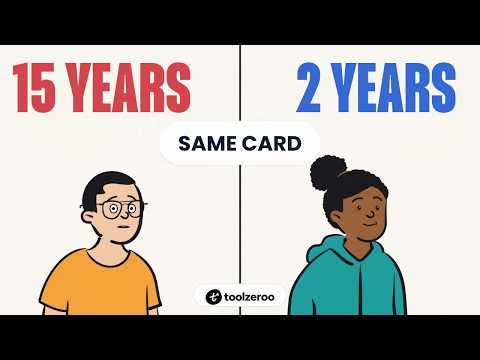
1:05 Same card, different number
Meet Maya. Same card. Same $3,000. Same 22% interest. One difference.
Maya: I pay a fixed $150 every month. Even when the minimum drops.
Ready? Go. Month 12. Maya's balance is falling fast. Sam's has barely moved. Month 26. Maya is done. Sam has paid every single month for over two years, and he still owes $2,310.
Sam: That's not fair. We had the same card!
Maya: Same card. Different number.
1:41 Where your $85 goes
So where did Sam's money go? Quick quiz. Of his first $85 payment, how much actually paid off the debt? Three. Two. One. $30. The other $55 went to this guy.
The Gremlin: Mmm, yummy. Interest.
Meet the interest gremlin. He gets paid first, every month, before a cent touches your balance. And he eats every day. On this card, about $1.81 a day. That's a cheap coffee every morning, poured straight down the sink.
Sam: Okay, but I pay $85, and he only takes $55. So I'm winning, right?
You are. Just very, very slowly. Here's the trick. Your minimum is often the interest, plus about 1% of what you owe. So as the balance shrinks, the minimum shrinks with it. $85. $84. $83. The gremlin's share barely moves. The part that pays down the debt keeps getting smaller.
Sam: So the card is helping me pay less?
It's helping you pay longer.
2:40 The warning box on your statement
And your statement actually tells you this, in a box a lot of people skip. Sam, open your statement.
Sam: Balance, due date, minimum. That's all I ever look at.
Look lower. On most US statements, this box is called the minimum payment warning. A US law, the Credit Card Act, makes card companies print it. If you only pay the minimum: about 15 years, and an estimated $7,433 in total.
Sam: $7,000? For a $3,000 card?
And right underneath, the way out. About $115 a month clears it in three years, for about $4,125 in total. That's only $30 more than his first minimum, but it never shrinks. 12 years sooner. Over $3,000 saved.
3:29 Five payments, one card
So the real question isn't, can I afford the minimum? It's, what number should I pay instead? Here's the same card, at five different payments. The minimum: 15 years. $100 a month: three years and eight months. Maya's $150: 26 months. $200: a year and a half. $300: one year. Now watch the gremlin's share. The minimum feeds him $4,433. Maya's $150: $771.
The Gremlin: That's barely a snack!
Start $65 above Sam's first minimum, keep it fixed, and he loses over $3,600. The first extra dollars do the most work, because they hit the balance he feeds on.
4:12 The one rule that beats the trap
Which gives us the one rule that beats the trap. Pick a fixed number, and never let it shrink. When the statement minimum drops to $80, or $60, or $40, your payment doesn't. Every dollar the card stops asking for goes straight onto the balance.
Maya: That's all I did. I picked $150, and kept paying it when the minimum dropped.
And if you can't afford more than the minimum right now? Then don't let your payment shrink. Keep paying $85 every month, even when the statement asks for less. That alone turns 15 years into just under five, and saves over $2,500 in interest.
4:51 The treadmill and the grace period
But there's one way to lose even with a good number, and it's where a lot of people get stuck. Sam keeps using the card. Groceries, fuel, a few takeouts. About a hundred dollars a month.
Sam: A hundred is nothing. And I get points on everything!
1% back on $100 is $1. The interest is about $55. Points only win when you pay in full. One year later, Sam owes more than when he started. After five years, over $6,000, and he's already paid the gremlin more than $5,000.
Sam: How is that even possible?
A second trap. On most cards, if you pay in full, new purchases are interest-free until the due date. That's called the grace period. Carry a balance, and on many cards it disappears. Every new coffee starts collecting interest from the day you buy it.
5:42 Maya's three moves
Here's how Maya stepped off the treadmill.
Maya: Move one. My fixed payment goes out automatically, the day after payday. Before I can spend it.
Automating makes a missed due date much less likely. A late payment can bring a fee, a higher rate, and a mark on your credit record.
Maya: Move two. The card goes in a drawer until it's paid off. Debit card for groceries.
No new purchases, no treadmill. Got more than one card? A common approach: pay at least the minimum on every one, then send the extra to the card with the highest rate.
Maya: Move three. I looked at moving the balance to a cheaper deal.
Some cards offer 0% for a while on a balance transfer. Read the fine print. There's usually a fee, typically 3 to 5%: $90 to $150 here. And when the offer ends, the rate jumps back up. It only works with a plan to clear it in time, and it backfires if the old card fills up again.
Maya: Fixed number. Stop adding. Cheaper rate, only with a plan.
6:47 Try your own numbers
Now it's your turn. Grab your statement, and open the free Toolzeroo credit card payoff calculator. The link is in the description. Watching on a TV? Point your phone at the code. Type your balance. $3,000. Your interest rate. 22%. And a fixed payment. $150. 26 months, and about $771 of interest. Now put in your own numbers. Then add $20 to the payment. Then $50. Watch the months fall away. The calculator keeps your payment fixed, which is exactly the habit we want.
7:23 Sam's do-over
So, Sam. If you could go back to that first statement?
Sam: Minimum payment, $85. No thanks. I'll pay $150. Every month. And the card goes in the drawer.
2028. Sam is done. 13 years early, with over $3,500 still in his pocket.
The Gremlin: Noooo! My snacks!
Quick note: this is general education, not financial advice. But the gremlin's not done. His next trick looks friendly: buy now, pay later. Four easy payments, no interest. So why do so many people end up paying more? Find out in the next episode.
Next episode
Buy now, pay later: four easy payments, no interest. So why do so many people end up paying more? The next episode is out on 22 November 2026. All videos
Related calculators and guides
Credit Card Payoff Calculator
Time and interest for your own balance and a fixed monthly payment.
Open calculator →CALCULATORDebt Freedom Calculator
The effect of extra payments on more than one debt.
Open calculator →GUIDEHow credit-card interest works
The same idea with South African numbers: a R30 000 balance at 20.5%.
Read guide →- CFPB: the payoff box on your credit card statement
- Regulation Z §1026.7(b)(12), the Minimum Payment Warning
- CFPB: Credit cards key terms (grace period, minimum payment)
General education, not financial advice. Card terms differ: check your own statement and card agreement. Animated characters; the voices are AI text-to-speech. Script researched and checked by Toolzeroo.